

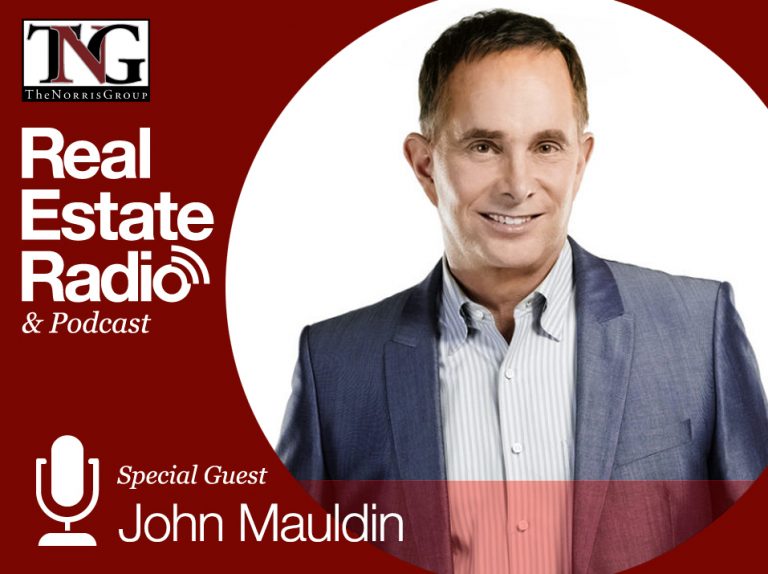
Bruce Norris is joined this week by John Mauldin. John is one of Bruce’s favorite authors and the chairman of Mauldin Economics, an economic and investment strategy research firm. He is also the president of Millennium Wave Investments. John is a renowned financial expert and New York Times best-selling author. He is a pioneering online commentator and publisher of “Thoughts from the Frontline.” This was one of the first publications to provide investors with free unbiased information and guidance as well as one of the most widely-read investor newsletters in the world. Each week 1 million readers turn to John Mauldin to gain a better understanding of Wall Street, global markets, and the drivers of the world economy. He lives in Dallas, Texas and is the father of seven children, five who were adopted.
John’s books are not easy reads, and Bruce thanked him for taking the time to write them. When you get ahold of one, you are thinking about the end game. Then you see they are really not terrifying, but they show what likely scenario could play out and what you would do to protect your family. In a way, they have both had very orchestrated and careful suggestions saying you can come out okay from these scenarios. They are not looking at doom and gloom, nor are they looking at buying firearms and dried food. They do feel there is an optimistic way to look at the future. You just have to make sure that you are not in front of the policies that central banks and governments are doing. You do not have to be since there is nothing requiring you to not set yourself out to where you cannot do well in the coming years.
Bruce asked John if at the peak of the problem of the financial crisis he felt that these policies were necessary during this time and shortly thereafter. They have continued far too long and are now actually becoming counter-productive. They are creating a scenario we are seeing today, and now investors are worried about what happens when you take them off the morphine. There is a moment in time when you have a financial crisis and liquidity when it is totally appropriate for central banks to inject liquidity into the system. You do not want the banking system freezing up. You could make the argument that part of the problem of the 2008 crisis was caused by the policies of the Fed going back into the early Greenspan era they created a bubble.
When there is a financial crisis, you do have to have a central bank step in. What they have done since then is tried to fine-tune the economy by adding a third written mandate to the public mandates. These mandates were to help boot asset prices. This is not the responsibility of the central bank. The responsibility for asset prices should be left to the market. The value of the stocks should not be subject to the Federal Reserve by keeping rates artificially low and therefore encouraging increased debt. The problem with the last crisis, as with most financial crises, is not too little debt but rather too much to begin with.
Creating a situation where you encourage people to want to borrow even more is like giving an alcoholic some whisky and telling him it is the cure to his drinking problem. What you want to do is encourage a lower debt or lower leverage profile. The correlation between lower leverage and total indebtedness, both government and private, and the actual growth of that economy being tight. When it gets over that 260-300%, then growth does decrease. There is a point at which the debt is no longer productive debt and has become consumption debt. When you are borrowing for the future, you are really taking future consumption and bringing it into today.
At some point, you have created so much future consumption that has been brought forward and you are beginning to dip into current consumption. The future consumption you borrowed finally comes, and you have already spent your money. Now you are having to repay it, so it is actually a depressant to growth over time. The point of properly-constructed leverage should be to buy an asset that produces an income that helps to pay off not only the interest, but the principal as well. This is a proper use of leverage. Simply purchasing something else may be a perfectly utilitarian decision for an individual. You may decide you want to buy a new car, and it would make sense for your current consumption patterned income to have this type of car.
John is in the process of finalizing a mortgage on a new apartment that he bought, and his is leveraged. This is the first debt he has had in a while, and it is normal for him to pay it off much faster than the term on the mortgage. He thinks it is an appropriate investment for where he is and the risks he will be taking. Simply borrowing money to put on a credit card or having a student loan for an asset that may or may not pay off over time. When everybody does this, eventually you bring so much consumption forward that you are going to reduce current growth. This in turn will require more stimulation, and this will be the less effective. It is nothing cataclysmic, nor is it anything going off the cliff. We are just slowing down because we have already consumed this year’s crop.
As one economist said, debt is future consumption denied. When we spend and borrow money today, we are saying in the future that we are not going to spend that money on consumption, but we will use it to pay the debt back. We all recognize intuitively that there is a limit to how much we as individuals can borrow and consume today. In reality, there is no limit to what cultures and countries can do. When countries get to that state where they borrow too much, they have to either go through a sole growth period to pay down that debt, inflate the debt away, default on it, or do something with it. The popular way to do this is to grow your way out of it, and the only way to do this is to stop incurring more debt. This becomes very unpopular and is called austerity. However, if you do what we did in the 90s, you will see that we stopped growing our debt and the naturally resilient U.S. economy eventually grew its way out of it. They began to pay the debt back down.
John said back in 2002/2003 they had Greenspan and other members of the Federal Reserve actually worrying about what would happen when we paid off all the U.S. debt. There is a certain amount of U.S. national treasury debt that with the way our current system is structured, there is a certain amount you are required to have just to make sure the bank can function. We have all been used to this, so people were openly worrying about what happens if we pay all this out but cannot grease the wheels or make the system work with that debt. The question is what we would substitute for this or how we would go about creating the things the investors and depositors of financial institutions don’t think about often. It is in the background, but it is part of the plumbing.
Bruce said it seemed that when it hit the fan in 2008, if they had a successful blueprint they could have looked at this is not what they did. They were making up policies on the fly since there was no plan or seeing what they had done before and applying it to now. They had to provide massive amounts of liquidity. The reality is that banks did not trust each other and the overnight repo markets collapsed, especially in Europe. John said he finds that the SEC and other attorney generals in Europe who start going after banks for falsifying their overnight rates, it is almost laughable. He was writing in 2008 that there was no overnight inner bank market, and therefore whatever number they were giving them was something they made up themselves. It had to be because there was nothing crazy and the people at the financial institutions had no way of saying at what they were trading. You then get the 16 banks together and find out the average of the inner bank market. It was clearly a fictitious number, and it turned out the regulators were encouraging them to do this. This will likely come back to bite us in the next crisis.
Banks are going to look back and see that if they do what is good for the system, which is in fact a lie. If all of those banks had gone to the industry association, which gave us LIBOR and $100 trillion worth of transactions, and they tell them nothing is happening. They would then have to announce that there is no overnight rate or LIBOR rate. The next day the world would have completely collapsed, so they lied with the full encouragement of the regulators. This will not happen next time since they now know that five years later a regulator will come up and tell them they will go after them because they are easy pickings. The next time the banks will say they can have a scout, but it will not be theirs.
They had some very short-sighted regulators, although we have gotten farther from where we were going. All of these little things come together to give us a climate that is manipulated, controlled, encouraged, and prodded by 12 men and women in a committee in addition to the governors of the Bank of Japan, members of the European Central Bank and Bank of England. They think they can manipulate their own economies and spur employment liquidity. In fact, what they need to do is get the governments to say to get out of the way because what we really need is more income, not more debt. We need to encourage entrepreneurs and businesses to provide more services, compete, and get out of the way.
At the time of the interview there was a State of the Union message. Bruce asked John if he thought he would hear any of these themes. He said he would hear platitudes, but what you will really hear from the president is more government intervention and involvement. John said he did not expect to hear what he wanted to hear, which is how government will make it easy for entrepreneurs to make money and businesses to create new markets. He said he wanted to hear about an increase in free-trade agreements and everything that is pro-business and pro-entrepreneur.
In essence, this is what quantitative easing was. It was the Federal Reserve injecting money into the top of system to increase asset prices. The banks made out like a bandit, and people who owned stocks and other assets have done very well. However, the average person on the street has not benefited as much. The spread grew as well as the resentment. In essence, you have people complaining about the disparity of income and wealth, but then you create a monetary policy whose primary beneficiaries are the wealthy. This ensures the outcome.
One of the things that has been a two-edged sword is you have low interest rates if you are buying real estate and getting some financing that is historically low. For somebody who spent their whole life savings, they are not getting rewarded very well. This is one of the great ironies. When they say they want to increase consumption, you then hurt savers by giving them less interest. This means they have less to spend and retirees have to be more conservative and not less. They are getting less money and have to worry about making their money last through the end of their lives. This is counter-productive. The current economic thinking does not see things as being counter-productive. It is very focused on consumption as being the driver of the economy rather than income or production.
Regarding the consequences that were discussed, some were unintended. Bruce wondered if there were any intentional consequences. One example was the low yield. They knew this had to occur, so Bruce wondered if this forces investors to make decisions other than what they would normally make. John said it does not force them, but it does prod and push them. What happens is we then get a reach for yield. They have seen credit spreads come down and you are getting less on your bonds than you used to get. You are having to take more risk for less return. The Fed wants us to take more risk because they think this will produce more for the economy. However, some of this risk does not necessarily increase productivity. It does not increase income, but rather it increases potential volatility in the next crisis.
If you have a high-yield bond and are getting 8%, whereas you used to get 12%, and you have to settle for $.75 on the dollar then that reduces your overall income a fraction of 1% on the entire portfolio. If you are making 12%, then this takes it down closer to 11%. However, if you are making 8% then that is a bigger chunk and you have less margin for error on taking more risk. Despite this, it is still the same company. You are taking the same amount of risk in terms of the lending you are doing, but you are getting less return for it. This has not increased productivity at all, but what they want is for businesses to go out and buy more tools, machines, and billboard buildings to take more risk. Lower rates do not always encourage the productive increase of the economy.
John had mentioned that he would like to see some free trade agreements open up. In essence, currency wars started with Japan and the yen. Bruce asked what they odds are of us going the other way and less willing to trade. The Japanese began devaluing their yen, so Bruce wondered if this will be followed by other currency. John said you will see a lot of countries try to increase their currency since everybody wants to grow their way out of the problem. Everybody wants their currency to go down so their businesses can sell more. The problem is everybody’s currency cannot go down at the same time. Somebody has to buy. There has to be somebody to run the current deficit as well as somebody create surplus. The Japanese are trying to get out in front of the process. They have just launched the first missile in this coming currency war.
Check us out on our website at www.thenorrisgroup.com and be sure to tune in next week as Bruce interviews Tim Herriage.
Be sure to check us out on our website at www.thenorrisgroup.com.