

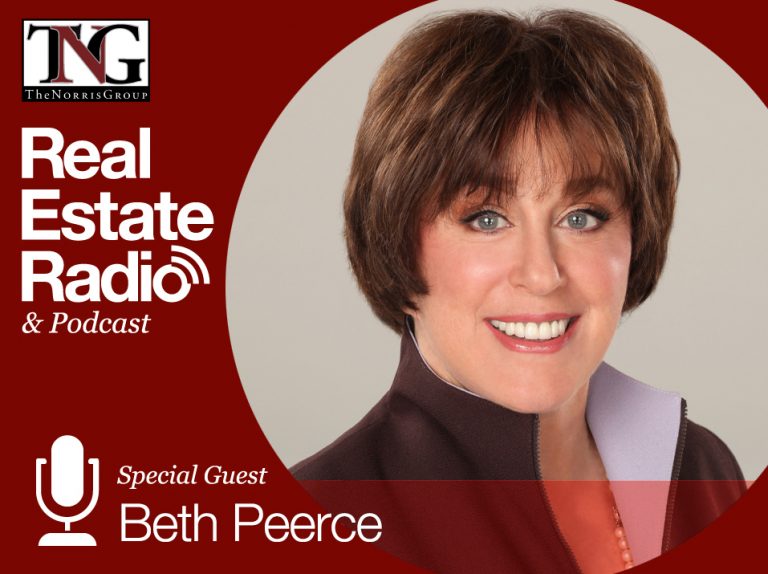
Bruce Norris is joined again this week by Beth Peerce. Beth is the vice-president of the National Association of Realtors. She is also the broker/owner of Primetime Properties in Century City, California and has been a broker for over 35 years. In addition, she has won several awards for being the realtor of the year in California.
Beth got into the business just about the time that interest rates were skyrocketing and going crazy. The one thing we really forget is usually there is some volatility attached to our industry. We have not had a prime rate change in five years. The most volatile year ever was 1980 or 1981 when you had 21 changes by the Fed. Imagine you are in escrow for 45 days and have three rate changes; this was when they were trying to lock in rates and did not really allow it. It was a disaster because once they qualified they found out they had to re-qualify at the new interest rate. Beth had one client who had to get a loan at 21% at one time. When people talk about these rates going up from 4 ½% to 4 ¾% or 5%, then that is crazy.
When Bruce Norris and Sean O’Toole went back to Washington D.C. to the archives Library of Congress, they were interested to see if interest rates were at their lowest in our lifetime. They literally went back to microfiche, all the way to 1850 and looked at newspapers. From 1850 on they looked at a Sunday paper once a month and looked at the real estate ads for interest rates. For a fact, interest rates were never lower in our entire lifetime. Going back to affordability, this is what it correlates to. When we had the downturn of all the prices and you matched it with an interest rate, ownership became a no-brainer. Yet people were afraid to do it, and you almost couldn’t understand it. You talked to the younger people and tell them this is the time to get into real estate. Interest rates are still at all-time lows. While prices have increased, they are not out of sight and much lower than they were.
Beth used to teach a class, and the difference between renting and home ownership and what you could do as well as the difference a 2-bedroom, 2 bathroom condo and buying it, you really got people to be surprised. They then buy, and this is something we should be showing people again now. The part you cannot quantify is the psychology of why people do things. Simultaneously to an owner hesitating at the bottom of a market, lenders hesitate to make loans at the bottom of the market. Legislation is on the other side of it saying we have to restrain everything at exactly the perfect time to say you can now be aggressive.
We actually inflicted some of this on ourselves. We should have reigned in some of those programs willingly, and they ran amok. Now we have Dodd-Frank. This was written several years ago, and Bruce still doesn’t know if we know 100% what it has turned out to be. Bruce asked if all the pieces are in place now, to which Beth said she cannot answer, and neither can most people in Congress. This makes quite a problem, and interpretation is very difficult to figure out. Bruce asked about the ramifications of this being true. Bruce asked if there are lenders who are just not willing to do any new programs since they are not sure it is okay. Our lenders have been very hesitant, and some of them very stringent in making loans.
We jokingly say that lenders are willing to make a loan to anyone who does not need one. Part of this is joking, and another part is true. This is why you cannot get rid of Fannie Mae and Freddie Mac without a government guarantee. You have to have a source for people to get a loan. If they are qualified, they should be able to get a loan.
Bruce asked what Beth meant by guarantee. He wondered if she meant that a loss would be absorbed by the government. Beth said there were not losses up until when loans were being made that no one had a right to make. The government was buying loans that they should not have been willing to buy because they did not meet any of the standards they said they would be meeting. What we need is good laws in place that tell us exactly what the rules are, then everyone will follow those rules. If people had been following the rules even then, the situation would not have happened. She is not as worried that the government will end up as Bruce said since they are now making a lot of money on making loans. It really is a wonderful program, and you do not have to have a government guarantee. There is no question that people will say they do not their taxpayer money to go there since every cent of it was paid back. Now they are making a very lovely profit on it. It was a bad time, but it was because people broke the law and nobody stopped them.
Bruce said the hardest thing to prevent is an overreaction on both sides. When things were good, we kept on doing more generous things because the mandate was everyone has to own a house, and we forgot that somebody was supposed to qualify. Now we have reverted to such a stance that the people who are self-employed have a lot slimmer chance to own a house. There are so many no answers given to such a safe pool of loans that he is wondering if there is not some private sector lender that is going to capture a decent share of business by having aggressive programs if there was enough money to fund it. This is the biggest thing. When you are talking about what Fannie and Freddie hold, which is around over $5 trillion of mortgages, and listen to people talk about how they will raise funds for buying rental homes, it may surprise you.
Bruce asked what the numbers are in hundreds of billions of dollars of transactions a year. If you take away Fannie and Freddie, you better replace them with some capacity to fund or guarantee. Beth said they do not really believe there are private funds that will drop in and do that. Beth said she has never seen it happen before and cannot imagine why it is going to happen now. Before they do away with it as opposed to just restructuring it, we want proof for our clients and constituents that there will be money there for the average person to go buy a home.
Bruce asked about the position of the NAR and how it lessened the impact of the Dodd-Frank bill in the last few years. Beth has been lobbying constantly for certain things to end up in certain places, so there are all kinds of categories in Dodd-Frank. Bruce asked about some of the victories where they said they were glad it changed to this. Beth mentioned the qualified-residential mortgages, the QRMs, and the QMs. The qualified-mortgage rule set standards for strong loans, but it did not make the banks hold more capital. This is a big thing, and they are under-writing regular standards, and those loans are performing well. Now they are trying to monitor and make sure their credit is available.
They came out with a rule regarding the QRMs, and what they are saying is you had to have a 10% down payment. Not everybody can come up with a 10% down payment, so they are trying to change what the rules were for the qualified mortgages and base them back on what the same rules were for securities sold to investors. They are requiring that the banks hold a lot more capital on those loans. This is fine, but you do not want to change the basic rule that was if a person can qualify to buy a home, then they are qualified. Why are you changing the rule just because of where it is being sold?
There is an assumption that a bigger down payment makes a successful payment history more likely. Yet when you look at a chart of VA loans with nothing down, it mimics the best of Fannie and Freddie. This has been proven time after time after time. It is not the amount of the down payment that shows whether or not the person will make it. It is their credit history and qualifying them based on them being able to afford to live in that home. If you qualify them based on that, whether they put 2% down or 25% down, the same people are going to make those payments. The VA loans are the perfect example, especially in California and this can be shown over and over again.
Bruce asked Beth’s opinion about charts that are historical and lengthy not making an impact. Bruce asked if you have a chart that makes sense but does not pan out the same way, would you have a willingness to change your mind. Since you are about to change an entire industry for the negative, don’t do it on a false conclusion and on what you assume would happen. Go look at the records and see for yourself. We could spend a lot of time lobbying and trying to show us these statistics and why we say what we say. We have Lawrence Yun and Leslie Appelton-Young to do this for us. There are still some lawmakers who say to not confuse this with facts. This is very difficult because we walk into their offices and find they are not really going to listen. They have their mind made up, and they spend a lot of time and energy going to Sacramento or Washington to try and lobby and get people to listen and be logical about their conclusions.
Bruce said one of the difficulties for anybody who is in Congress is that they deal with a lot of subjects in addition to real estate. Thinking about the expertise necessary to discuss this, Bruce is not sure how many would even understand what he has been discussing since this is not what they did. Beth agreed, and this is why we need more realtors in Congress and the state houses. They do spend time training their realtors on how to run for public office, even if it is the planning commission or whatever their local group needs. You do need people with the basic knowledge of that subject. Beth is interested in it being realtors and people who understand real estate. However, if it is somebody who is a tech specialist, that certainly helps your government to run correctly. There are some realtors in Congress right now, and they are very pleased because they seem to know and work to get things that make logical sense. These are the people Beth said she is thrilled when they get elected.
The Consumer Financial Protection Bureau is a new government entity that is now in full force. Bruce asked what the intent of it is and if it is going to try to prevent making loans to people who really shouldn’t be given financing. Beth was not sure, although she heard different things about what their real thought pattern is. Bruce said what is interesting is you are in a situation where apparently there are a lot of layers with which to deal. We have created the Consumer Financial Protection Bureau on top of what is there, and sometimes on top of what was there even before that. Bruce asked if people in the mortgage business and realtors start looking at these regulations and see the conflicts and confusion and wonder why they need so many different hats and rules. Bruce would know from being an investor that if you already have six people dealing with that right down the street, then why would you start another commission and idea? They understand that everybody is trying to make sure that what happened five years ago does not happen again, and nobody has a problem with that. We all think that is a great idea, but why don’t we use those rules we have, enforce them, and go from there.
Bruce does not think it is helpful to be punitive at this point. This does not do anyone any good, and it does not help an economy nor the couple who could have owned a home. Bruce also asked about policies such as immigration. We keep on batting that subject around. If you had something similar such as in the Reagan years happen in 2014, Bruce wondered what the impact of real estate would be if we had immigration reform. Beth said she thinks there is going to be immigration reform and it is time for it to happen. She has had fabulous experiences with immigrants who come to the country and want to be part of the United States. She said she is probably not a fair judge since she has had a lot of foreign immigrants, especially Asians. These people come wanting to be a part of America, and to them this means owning a piece of it. Beth said it has worked out phenomenally, and she does not have a client who ever went into foreclosure.
She had done some pre-qualifying, and they said it cannot be done since she was asking personal questions. However, if she is going to find them a home then she will need to know personal things about them. This may not be politically correct, but none of her clients ever objected. Once you find the price range that they are comfortable in and can afford to make those payments. She thinks immigrants make fabulous buyers because they are the people who came here because they wanted to be here and wanted to be part of America. Sometimes they personally show up, but other times their money shows up. In California, about 8% of real estate sold went to foreign investors. That percentage is a lot bigger than it was in the past 3-4 years. They are seeing the bargains and saying the same thing. Real estate is at an all-time low, so they are asking themselves why they are not buying it.
There are many countries that say foreigners cannot buy coastal property or farmland. We do not have any rules like that, so people are going to come in and buy what they consider to be the best buys out there. Beth does not personally deal with a lot of foreign investors, so she is not as excellent in that field as Bruce probably is and knows about it. She has mostly dealt with people whose kids were going to UCLA and they did not want to rent. When you would tell them their kid was only going to be there for three more years and asked them if they considered renting, they would look at you like you were crazy and ask why they would pay somebody else money rather than having the house themselves.
Bruce said he is unintentionally being quite promotive of real estate just because it has certainly been a big deal for him and his family. This is why you get into the industry because you see it has treated you well. Beth said it is the same for many of us. She got in it for her mother, and Bruce got into because from personal experience he found that it was a great way to do things. For Bruce he did not know how else to pay off the house quicker than in California. The one thing that has been very interesting during the time he has been involved was regarding marriage. He got married at 17, and his generation typically got married in their early 20s. This generation does not do that. You look at all the charts of household formation that is supposed to happen, but the kids today did not do what anyone else did. They do not get married at 22, but rather they get married at 29.
Beth thinks you are seeing a different phenomenon in that single people are buying homes. Beth used to work for a company called Glendale Federal Bank in the real estate division. There was a phenomenon that started where single women were buying homes. Before, nobody had even thought to tap that market, including Beth who was a single woman at the time. All of a sudden she found that they had a tremendous amount of buyers in the single woman club. Now we are seeing a great many young men at 25 and 28 who got out of school, got their first job, and they were ready to buy. When you ask them if there is a family involved in it, there will be. If there is not, they do not seem to care since they just want a house and a place to live, have their friends over, and not pay rent anymore.
Bruce asked about the product in which they are interested. Do they want to have a yard, or do they want to live on the fifth story of a high-rise. Beth said it depends, but most of them actually want to live on the fifth story of a high-rise. The reason he asks this question is because of where she is in the area, it might make more sense. Depending on where your marketplace is, this answer could change drastically whether or not they want a pool or a backyard. However, Beth said where she lives most people cannot afford the houses at that point. However, they can afford the condominiums. This skews the answer. If they could afford it, then maybe they would want it anyway.
MORE ON HARD MONEY LOANS
- Florida hard money loans or call (407) 706-9700
- California hard money loans or call (951) 780-5856
INFORMATION ON NOTE INVESTING
- Florida mortgage investing or call (407) 706-9700
- California trust deed investing call (951) 780-5856
REAL ESTATE INVESTOR EDUCATION & RESOURCES
- Upcoming real estate investor speaking engagements and training
- Real Estate radio show and podcast
- Weekly news and videos
- Free Investor Roadmap – How to get started in real estate investing
- Free access to our web portal for real estate investors