

On Friday, October 24, the Norris Group proudly presents its 7th annual award-winning black-tie event I Survived Real Estate. An incredible lineup of industry experts will join Bruce Norris to discuss perplexing industry trends, head-scratching legislation, and opportunities emerging for real estate professionals. Proceeds from the event benefit Make a Wish and St. Jude Children’s Research Hospital. This event could not have been possible without the generous help of the following platinum partners: Auction.com, HousingWire, PropertyRadar, the Apartment Owners Association, the San Diego Creative Real Estate Investors Association and President Bill Tan, InvestClub for Women and Iris Veneracion, San Jose Real Estate Investors Association and Geraldine Barry, MVT Productions, and White House Catering. For event information, visit isurvivedrealestate.com.
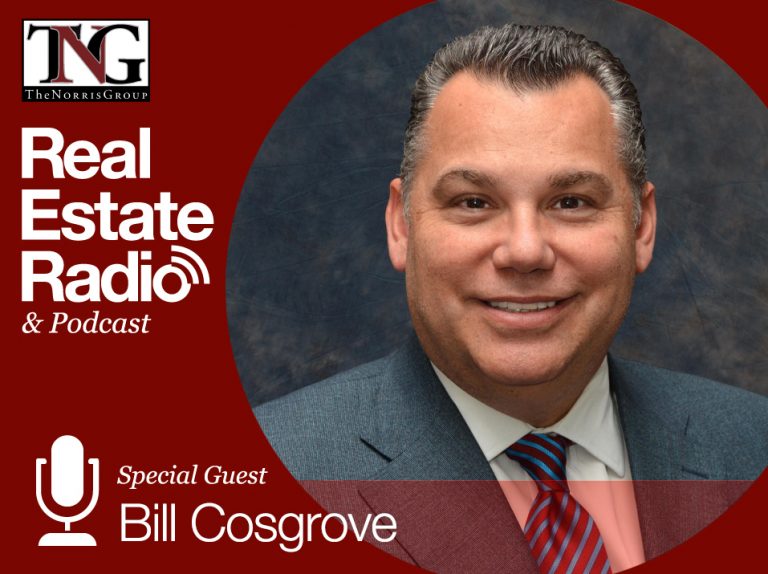
Bruce Norris is joined this week by Bill Cosgrove. Bill is the chairman elect of the Mortgage Bankers Association. He began his career in the mortgage banking industry in 1986 as a loan officer and has served in many positions for the Mortgage Bankers Association. This includes the president of the Ohio MBA from 2007-2008. On October 19, Bill will officially be sworn in as the chairman of the Mortgage Bankers Association.
Late last week Bill was in Washington D.C. meeting with the administration and other people from HUD and the Treasury. He had also attended the Mortgage Banking Convention in Charleston, South Carolina. In just another week he has his regulatory compliance get-together from September 28-30. Bruce asked how his industry is coping with the changes and if most of the changes now are a known commodity. Are we ready to get on with business as usual? Bill said the new norm was with them, and after QM came out this past January it has settled down a little bit. The 800 pound gorilla and next shoe to drop is for the residential side. The new respa tila documents will come out in August 2015, and everybody is geared up for new good faith estimates and truth in lending. This will create some shockwaves in the industry, but this is what they are working on next. They are also working with the regulators in Washington to try to streamline things and get the regulations right so they can get the housing markets back on track.
Bruce asked about when the regulations are implemented in August 2015 and if it will make the process simpler for the mortgage industry and more understandable for the borrowing client. Bill said that it will probably not unfortunately. The respa tila documents that are coming out were mandated with Dodd-Frank in 2010, and it is the last major piece of the puzzle put in from Dodd Frank. Unfortunately, they do not believe the documents will be an improvement and will probably complicate things more. At MBA, they really want to work with the CFPB to do everything they can to streamline them. However, they do not believe it will be an improvement in the current system. They have to work with CFPB to improve what is possibly going to be a difficult process.
They still meet about things that could still possibly be implemented or changed in the respa tilla documents. There is a lot of good they have done with CFPB. With QM they listened to the MBA a lot, and they had a lot of constructive dialogue around points and fees and creating a safe harbor if the loan is under 43%. They have done a lot of good work with the CFPB in a lot of different areas. However, when it comes to respa tilla, there is still a lot of work to be done between now and August of 2015. This piece was mandated by Dodd-Frank, and the CFPB is acting upon the final pieces of this law.
Bruce asked how long the CFPB has been established and if it is fully functional at this point. Bill said it was established as part of Dodd-Frank around 2010, so it is about 3 ½ years old. They have ramped up from ground zero to about 1600 employees. It has now grown into payday lending. There have been several headlines about auto loans, so it is like a spider web where it is really branching out even beyond real estate. Hopefully when it comes to the mortgage space there is a lot of work that has already been done. Hopefully after respa tilla there will not be much left to do in their space.
Bill has been in the industry almost 28 years, and Bruce said he would imagine the last six years have seen more changes than he would imagine he would see. Bruce asked if we are at the point where we are able to loan to credit worthy people, such as people who used to get yes answers that were on the margin. Bruce asked if they are still not participating and being able to buy property. Bill said at MBA they have very clear statistical data that has been in recovery at the top. With all the regulations in place and the credit buckets being very tight, what they have seen is the middle class and low end of the market, especially first-time home buyers, have really suffered from the increased home regulation and decreased credit bucket. Nationally the first-time homebuyer, which is extremely important if not the most important part of the ecosystem of purchasing a home in the market, has been 40% of the market. Today, that number is between 28% and 32%. There has been a good recovery at the top of the market, but the bottom of the market is still suffering, and they believe it is the regulation that has made the lenders very conservative with the credit buckets.
Because of the legal risk of buybacks and repurchases, he believes there are some borrowers who are qualified but are not getting loans. If they are on the fringe, it is easier for a lender to say no than face the possible consequences of doing that loan. Even though they feel, by and large, these people would make the payment there is a chance they would have to buy back the loan at some point. If they are very close on qualifying ratios and on credit scores, today the scrutiny where if you are a lender and get the paperwork and documentation 98% right, that 2% they get wrong will kill them and trigger a buyback. Today buybacks are being triggered by not so much material errors, but the “I got you” kind of errors. Until we change this climate in Washington with the regulators, you are not going to see lending to the point you should. The comments made over the last month by people at Wells point out that people are publically questioning why we would lend at the bottom of the market if we will be penalized by doing so. For them to come out and say this publically is a strong statement.
The sins of the industry were committed in 2003-2006 and the fines have been levied. Every month there is another $10 billion fine paid by a major lender. Bruce asked how this affects the mood of aggressiveness. He said to him this would be pretty discouraging to say they will not do anything wrong. The fact of the matter is what the Mortgage Bankers Association is doing is working with the legislators and administration to put the past behind us since we have paid for the mistakes. It is time to wipe the slate clean, even if the regulation has overreacted to the problem. The pendulum swung in the opposite direction, and data shows the housing recovery is slogging back and forth because of tight regulations. They are saying we should take the regulations and, instead of swinging it to a very conservative place, we should get it back to the middle where we have proven as an industry that we do need to be regulated. However, it needs to be smart regulation so we can get back to responsible lending and building a solid real estate market. We need to go from vindictive changes to constructive ones.
A couple things that just came out regarded waiting seven years after having gone through a bankruptcy or foreclosure. It is now a shorter timeframe. This seems to be a positive leaning in the right direction. This may be a great example of evidence that this regulatory pendulum has swung too far in the conservative route and may be coming back to the middle. Bill is in charge of a national organization, but he works in a location, namely Ohio. Here prices are not as volatile as they are in California. When FHA lowered the loan limit in Bruce’s town from $500 grand to $350, they changed the dynamics of a lot of things, including what builders will even think about building. Bruce’s sense is that this is not the only reduction that might be in place.
Bruce asked if the mood in Washington is to keep on reducing FHA’s footprint in the marketplace. Bill said that a year ago the answer to this question would be yes. However, today the policymakers and regulators see that the housing recovery is stalled. This may have been a reaction to FHA when they need to bailout in the reserves and the MMI fund went negative and they are supposed to be up to 2%. There were some policymakers in Washington who wanted to get the government out of the lending business and take it private. The bottom line is the housing in America is too big to be completely private. It has not been private since 1935; so at the end of the day it might sound great but it is not reality. This was a knee jerk reaction to what was going on with the MMI fund, but now that the recovery has stalled you see the attitude is a little different. Just like with Fannie Mae and Freddie Mac as they were talking about raising G-fees again, this has stalled as well. By lowering these rates, it will hurt the market.
Out in the higher priced areas in the East Coast and West Coast, they do the same thing with the GSEs. A year ago he would have said this was going to continue, but now the regulators and policymakers have paused because they do believe that will probably stall the markets even farther. Now it is a little bit of a different environment. Bruce asked about when we started 2014 and if the mood towards the kind of year we were going to have different from the reality we have experienced. Bill said simply the answer is yes. Just like weathermen, economic forecasters hate when you remember their forecast. What happened was the chief economists for Fannie Mae, Freddie Mac, and the MBA all had the purchase business home sales up about 15% versus last year. What has happened year-to-date is not only are they not up 15%, but they are down about 10%. The housing market has really not performed the way the experts expected it to, and this is a wake-up call to the policymakers and regulators in Washington. This is some of the byproduct of what we are seeing.
Bruce felt like 2014 would be a good year in California for both volume and price increases. If you looked at the volume of sales in 2013, you had an expectation that the volume should go up. However, the problem was they looked at the chart of volume but did not analyze what made it up. The buyer was not that first-time buyer who was going to grow up and buy the next and build a home. The volume was on the backs of hedge funds, foreign investors, and cash buyers in quantities they had never seen in years past. This happened more out on the coast in areas like Florida and other areas of the East Coast. This was a buyer that is not your family and the type they have never seen. This is not the type of buyer who will sustain a housing market over time.
Bruce asked Bill the reasoning he has heard of why 2014 stalled. Bill said the largest reason is access to credit since it is more difficult to get loans. Another reason is the job market. Talking to loan officers, he often tells people that in 28 years he has never seen anyone take mortgage applications and buy a home on only part-time work. At the end of the day, it is full time jobs, then after that it is jobs and access to credit. The job market is still soft, and with tight access to credit you have this problem. For the first time in his 28 years in the mortgage banking/real estate business, student debt that young people are coming out of college which is preventing them from being a homeowner in their mid to late twenties and possibly early thirties. Bill said jobs is the number one thing, while access to credit is number two. Exploding student debt is number three.
What is interesting about the student debt from Bruce’s research is that all the numbers are correct, but the makeup of the debt was surprising. He would have thought the under 30 age group would have to have the lion’s share of that debt. Instead, they have 33% of the debt, and the group between 30 and 40 has another 30%. In addition, those over 40 have another 30%. What is interesting about this is you have people who are already mature in the work force having to retool their skills and borrow money in order to get re-educated. In a way this is healthy sign, but it gets in the way when your back end ratios are so tight that if you have college debt and a monthly payment, that is hurting your qualification.
Statistically the MBA studies show that today a college graduate comes out with $35,000 of student debt, and this is a heavy burden. Over the last two decades as inflation is going up 1-2%, most universities have been pinning their tuition costs up 8% over a twenty year period. Higher education is extremely important to this county. Most people need to have that college education, but the fact of the matter is the universities have gotten away scott-free without being questioned and get a free pass when it comes to politics. Today, the middle class of America should not have to go broke educating their children. This is exactly what is happening today, and something is wrong with that. If you looked at that chart, you would see a very similar chart next to health care costs. It is wrong, and at this point politically people have gotten a free pass. In mid-America there is a lot of anger that has been built up to the cost of higher education. Politically they have gotten a free pass, and this has to end.
In the research that Bruce has done, he has looked at newspaper advertising in the 1935 era. You could get real estate loans, you just had to have 50% down. The problem with that is you would not have a housing market or consider owner-occupant very important. One would hope as a country we would not get away from this. This is something that will be discussed on the panel at I Survived Real Estate 2014. Bruce said it looks to him like they are having a profitable year now, and this would come under the category of whether or not we really want to get rid of something. This would seem a little more vindictive than constructive at this point. There is no doubt that there needs to be reform.
Where we are at today with the GSEs cannot be maintained. He does believe that with the type of structure the GSEs have that a very well-protected government guarantee needs to be in place for there to be enough liquidity in the housing market moving forward. There does need to be reform, but at the end of the day we do need a government guarantee as well. We know that investors around the world would purchase those bonds as we know the underlying loans are high quality. This is where the industry is at today, so there is no doubt that the GSE reform needs to happen, but the entities as they are today are doing just fine.
The Norris Group would like to thank its gold sponsors for supporting I Survived Real Estate: Adrenaline Athletics, Coldwell Banker Town and Country, Elite Auctions, In A Day Development, Inland Valley Association of Realtors, Investor Experts, Jennifer Buys Houses, Keystone CPA, Las Brisas Escrow, LA South REIA, Leivas Associates, Pilot Limousine, Primary Residential Mortgage, Northern California Real Estate Investors Association, North San Diego Real Estate Investors, Real Wealth Network, Realty 411 Magazine, Rick and LeAnne Rossiter, Personal Real Estate Magazine, SONOCA Corporation, Southpointe Companies, Spinnaker Loans, Tony Alvarez, uDirect IRA Services, and the Council of Multiple Listing Services. See isurvivedrealestate.com for video of the live event and more on our sponsors.
For more information about The Norris Group’s California hard money loans or our California Trust Deed investments, visit the website or call our office at 951-780-5856 for more information. For upcoming California real estate investor training and events, visit The Norris Group website and our California investor calendar. You’ll also find our award-winning real estate radio show on KTIE 590am at 6pm on Saturdays or you can listen to over 170 podcasts in our free investor radio archive.