

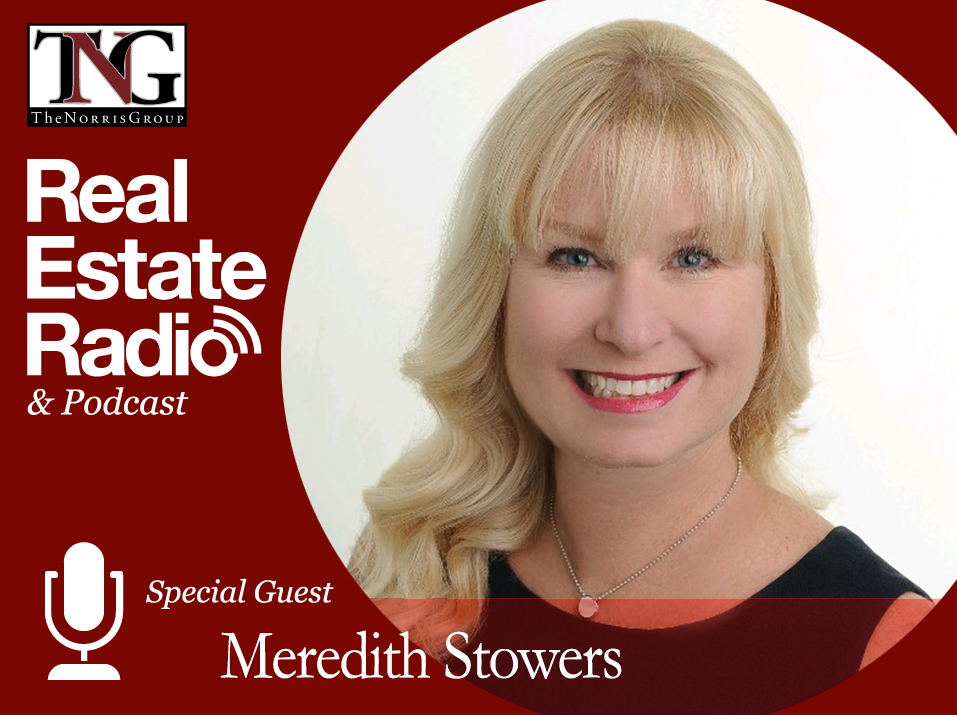
Aaron Norris is joined this week by Meredith Stowers. Meredith Munger Stowers (formerly Leyva) helps people achieve their goals. Stowers currently handles marketing and business development at CrossCountry Mortgage and ADUlonas.net with a focus on helping families, buy, build, renovate and refinance property, notably Accessory Dwelling Units, (ADUs). She operates ADUloans.net and serves as a founding member of the ADU Coalition, an advocate for attainable housing.
Aaron and Meredith continue our ADU series with some of the only ADU financing available. Enjoy.
Episode Highlights
-
- ADU’s
- ADU Financing
- SB9 & SB10
Episode Notes:
Narrator 00:00
This is The Norris Group’s real estate investor radio show the award-winning show dedicated to thought leaders shaping the real estate industry and local experts revealing their insider tips to succeed in an ever -changing real estate market hosted by author, investor and hard money lender, Bruce Norris.
Aaron Norris 00:21
Hey everybody it’s Arron Norris. Welcome back to the radio show and today we’ve got Meredith Stowers, she is currently marketing and business development at Cross Country Mortgage and ADUloans.net with a focus on helping families get into refinancing properties with Accessory Dwelling Units in my shop race ADU loans.net and serves as a founding member of ADU Coalition. She recently wrapped up her national syndicated column, The Marketing Coach in the business journals, in the business journals. And previously, she was chief operating officer for voices or media, leading social media application and consulting company, which included clients like Disney and Scripps network. I had no idea that you had such a background in marketing, so.
Meredith Stowers 01:04
Yeah, I know, good question. And the answer is, you know, my mission in life has always been kind of helping people in some way, shape or form, there’s always, we’re always learning stuff all of us. And if I can make somebody’s life a little bit better, and housing is one of those critical elements, you know, the real estate markets really changed. If you look online, at the cost per square foot, you know, in the Southern California market, it’s typically 800 to $1,000 per square foot. Whereas with the ADUs you’re looking at around 325 per square foot, maybe 350. Of course, prices are going up on everything. So, the volume is switch and, and yet construction is terrifying for so many people. So, if I can help handhold them through the process and get them financing. That’s even better than purchasing, I’m going to do it.
Aaron Norris 02:01
Well, and before we get into ADUs real quick. I also wanted to mention your nonprofit. Number 1, I don’t know how to say it. I’m afraid I’m gonna say it wrong.
Meredith Stowers 02:10
Thinkhouse. Yeah, so Thinkhouse.com is a actually that was an online community for military families, it was the largest out there. And simultaneously, we created Operation Homefront, and built into the fifth largest charity, you know, in America to help military families. And that also went hand in hand because when we could see family struggling with deployments and things like that, we could leverage the charity that is swing into action and help makes a big difference. And a lot of that is setting expectations, goal planning, man helping young wives manage finances and so on, because often they’re left on their own. It’s not the guys doing it. It’s the women who are steering those decisions.
Aaron Norris 03:00
Yeah, when the men go off war, which there’s still a lot more men than women who get too much. Yeah.
Meredith Stowers 03:07
Yeah.
Aaron Norris 03:09
Interesting. That’s, uh, I can’t, when you said it was the fifth largest nonprofit serving military.
Meredith Stowers 03:16
Yeah, was the fifth largest nonprofit serving military families. So, I haven’t been involved with it for a little bit. But again, it goes back to just trying to help people and even though I work in mortgage lending now, with my husband, you know, it’s all a theme of helping people and you know, do something great in their lives.
Aaron Norris 03:36
Alright, so ADUs come on the scene. You were one of the only lenders at the time who even knew what ADU meant, like, why was it attractive to you? Because it was messy.
Meredith Stowers 03:48
Yeah, ADUs were messy. They are messy. And, you know, my husband, I gotta give kudos to my husband, Michael, who’s honestly a financial genius. And he’s been in mortgage for 30 years. And he’s seen every type of loan and he’s not afraid to creatively solve problems. And that got me excited because renovation and construction loans are hard loans. And so if, if you can get our, if we can get our manufacturing process on the loans down to a science, and have a better experience than what most of you know, the situation is. That to me was a blue ocean strategy, and not just for our business, but for the people we’re helping. I just see these prices go up and up and out of reach for so many people trying to buy a home and construction makes all the sense in the world. What I also love about ADUs is it keeps families together. I see a lot of multi-generational families especially during COVID and Mike and I have six kids between us and many of them are adults now and about to have children of their own. And it just occurred to me, you know, how great would it be if we weren’t all crammed into a house during COVID, but we could have our privacy and individual families and it would be less expensive for the kids than to buy a house and you create this family compound where the grandparents can help with the, with the little kids. But also our, you know, my in laws really need help now and so to be able to look after them, is kind of a good fit for everybody.
Aaron Norris 05:36
For those of you not in California who may not be is in tune to ADUs, ADU stands for accessory, Accessory Dwelling Unit. And these are secondary structures by right now, the state has mandated that if you own a property, you have the right to build a secondary structure up to 1200 square feet, very minimal parking requirements and very minimal impact fees if you build under 750 square feet. So, part of today, I mean, we have a lot of investor listeners, I want to cover this angle because so many consumers are looking to build but also buy houses with ADUs. And it’s just really important to understand what the lending has done in the last couple years to adjust to the new reality. It’s just been really crazy.
Meredith Stowers 06:19
Absolutely. And it’s not just California, cities across America and particularly in the southeast, have adopted ADU laws usually just one ADU. ADU is mortgage jargon for Accessory Dwelling Unit and the problem is with that is when I go, if somebody is going to build a duplex or a triplex, I can actually factor in rental income with that, with the ADUs I’m not allowed to mortgage jargon says that an Accessory Dwelling Unit could be a pool house or a companion unit. But it’s usually something that doesn’t generate income. And that was politically expedient, who can possibly be against grandma having a granny flat. But that’s why these are called ADUs. So, we got really good at those. And we have a new White House. And Sandra Thompson, the new head of the Federal Housing Finance Authority said they intend to double the stock of housing on both coasts using ADUs. So, that’s how big of an investment is. Yeah,
Aaron Norris 07:33
I didn’t know that was it had made it up to Washington, I still thought it was just a select few states.
Meredith Stowers 07:39
We’ve had a number of meetings actually with the White House, trying to convince them to treat ADUs like, like rental properties to some success, but not much. So, for example, it’s really important and this is why Aaron you and I work together. Fannie Mae is no longer financing ADUs on multifamily homes. So, sometimes we have to go to private money to build. So, in California and even some cities like San Diego, you can build multiple ADUs on a single family home unit. I’ve seen one property that has single family home, they’re building eight accessory dwelling units. And there’s no way to finance that in either traditional residential or commercial. So, you’ve got to, that’s where the private money comes in. But it makes sense. Fannie Mae won’t even let me do a rate and term refinance on a property with ADUs and we’re seeing trouble now with purchases. I know, they will not touch them. They do not want to support investors, they’re really pulling back out of the market. And that’s not a bad thing. Because the market is really going back to what historically it’s always been. Yes, there’s a portion financed by Fannie Mae and FHA. But there’s a huge portion of non traditional lending and what I would call common sense lending.
Aaron Norris 09:03
Well, let’s cover the San Diego thing really quick because this is important to know, the state has mandated it set the guidelines it set the bar, it doesn’t mean that your local city or jurisdiction can’t be more aggressive. Some cities are allowing tiny homes which fall under DMV regulation. It’s not real property. It’s personal property.
Meredith Stowers 09:23
Right.
Aaron Norris 09:24
Yeah, you just you really have to unfortunately dig in a little bit more to find out what the local regulation is around it. San Diego has been one of the cities that has been the most aggressive. So, eight on one single family lot?
Meredith Stowers 09:37
Yeah, so um, okay, and let’s go back to what is an ADU? Essentially it it can look exactly like a rental unit up to 1200 square feet well 1200 square foot house. Most of them are three bedrooms, one bathrooms. So, these are pretty big houses a junior ADU in California. is typically has to be attached to the primary home. And it’s usually a garage conversion. Well, that can fit a one bedroom or Studio, you add some decking out there, and it feels even bigger. So, these are pretty sizable units. Right now, the standalone ADUs are typically costing about 300,000 to build, that’s nothing compared to buying a 1200 square foot house at an average price in San Diego right now is 789. And it’s much higher across the state. So, it’s double the price to why, why pay double the price when you can build a custom brand new house for half that price. And then, and then same thing with apartments. So, a 300,000 when you finance it as part of mortgage, a $300,000 unit is about $1,300 per month, but rents for that in San Diego are closer to 4000. In LA, it’s 5000 barely, you’re looking at 6000. So, the cashier, cash flow on those make all the sense in the world. But let’s say you got adult kids or whatever, it’s super cheap. So, to give you a sense, when you finance these, it’s for every 100,000 you spend and 100,000 is very typical for garage conversion. It’s about 450 per month, and the rental income is just the cap rates on these things are just unbelievable.
Aaron Norris 11:34
Wow, yeah, I, I, in my presentation, I’m still teaching on ADUs. And now we’ll get to SB 9 and SB 10 today as well. I still really love ADU laws, because it’s very crystal clear what the state allows and then the jurisdiction has had to update their ordinances to follow suit. It’s, It’s so interesting to see what people are doing. And I’ve pulled data from the National Association of Homebuilders that say on average $100,000 In impact fees across the board.
Meredith Stowers 12:06
Yes.
Aaron Norris 12:07
To build something. And then when you’re talking about land, if you are going to buy a lot in San Diego to build said 1200 square foot house from scratch, how much would that be? 500? Grand?
Meredith Stowers 12:15
Oh, it’s a, yeah, absolutely. So, let’s start with the fact that it would take three years for the permits on a custom home. And this is why SB 9 is so important, we’ll talk strategy on that, three years and minimum 40,000 probably close to $100,000 on, on just for the right without a shovel in the ground, just for approval on the designs, then you have literally 50,000 for just the right to hook up water, and 50,000 for just the right to hook up electricity. That is the average cost of custom homes. And I personally did that article on behalf and did participate in that city and the half of the Building Industry Association. And, and then there’s actual construction. So, again, 1200 square foot home is 300,000 you go any bigger and you’re easily looking at 500,000. So, and that’s why the big builders like the KB homes and even the middle sized builders, they’re not building at affordable housing rates. They’re building million dollar homes, because because you can’t afford otherwise. Right. So, this is where ADUs are so affordable. And then in you brought up SB 9, which is even more exciting. Now SB 9 allows it’s, again, it’s a political play, they’re tiptoeing into the water, because they’re allowing their people to owner occupied homes to split their lot. It has to be a minimum 40/60 lot It can’t just be a little corner and, and those, and then at that point, you can sell off the lot all kinds of things. So, I asked Gary Geiler, the head of the city of San Diego because I get this question all the time. “Well, do you build the ADU first and then split the lot? Or do you split the lot first and then build a custom home?” Well duh? What’s cheaper and easier?The ADU so I asked, her I said so if I build an ADU and split the lot, he said, Would you permit this as a custom home if I built it to that specs? And he got a little growly at me. But ultimately he said, ‘Yeah, I’d custom build it. I charge it 40,000 for it, but yeah, I permit it.’ Well, shoot, that’s a no brainer. I mean, it’s…
Aaron Norris 14:44
Right. Well, one of the caveats of the, the law is that the cities have 60 days to approve these things if you’ve got a complete application. That’s one of the reasons I don’t like SB 9 is because it’s very vague. You go to the back of the line and the cities don’t like it. So, if you look at the the bill review who was against it, it was every city.
Meredith Stowers 15:05
Yes. So, and in realistically, I’m seeing turn times on ADU, ADU projects at four months, still way better than we’ve had. I think that the regulations are going to come from what I’m hearing are going to come out of the Department of Housing and Community Development, which regulates all these localities on these rules. I think SB 9 is ultimately going to change it to a six month turn time, and 30 to 40,000 and max, so I think, again, it’s helping California’s permit departments have really had their way. And this is why a lot of people don’t build in California, because it’s so subjective, and they’re trying to change some of that. But even so, you know, a lot of people think California is unaffordable. I think California is a very interesting market, because the, number one the rents are so high, people in California sale go buy in Ohio, or Florida or whatever. Yeah, but then you’re getting Ohio and Florida rents. And California is much higher, but to California has really lagged behind every Western city, coastal city in the world. And that we’re living the single family dream, that isn’t reality. So, you’re going to the next 10 years, you’re going to see lots splits, you’re going to see condo tising of ADUs. And you’re going to see it build up the way that Boston is or DC or that kind of thing, because there’s just not enough living space. And so really, if you’re buying a house with a big lot at 700, 800,000, that could be three homes in one.
Aaron Norris 16:56
Yeah, well, let’s, let’s back up a little bit. SB 9 was passed last year. And it basically does away in urban areas with single family zoning that allows you to do a lot split. And it does allow you to basically either build a separate house and then ADUs on the both. So, one single house basically becomes a four unit.
Meredith Stowers 17:17
Right.
Aaron Norris 17:18
And that’s at the state level. So, that’s why so many cities are so upset the minimum lot size, by the way, once the last splits takes place is 1200 square feet from what I remember.
Meredith Stowers 17:29
Yeah, and that remember, that’s just a first blush, because as soon as once the politicians realize there’s not that much backlash, they’re waiting for the NIMBY backlash, and so far, there really isn’t. And then you start to see them expanding. Well, maybe we could go a little less, you know, it was square footage. Or maybe we can include non owner occupied homes, or…
Aaron Norris 17:52
I think they learned their lesson with ADUs with the cities playing around and say, Oh, we allow a to use, you just have to have a minimum lot size of 20,000 square feet. And these are some of the games. Even Berkeley that was my favorite. They’re like we allow ADUs, but they were charging regardless of size 50 grant impacting somebody don’t pretend like you’re for housing when you do that kind of nonsense. It’s crazy.
Meredith Stowers 18:13
Yeah.
Aaron Norris 18:14
So.
Meredith Stowers 18:14
Yeah, I agree.
Aaron Norris 18:16
SB 9 is a lot of the development departments are not happy because it takes local control away from zoning. Now, they got all their RHNA numbers, all the affordable housing. Everybody’s different. Actually, LA just got in trouble. They got theirs pushed back. Because it wasn’t enough. They weren’t going to meet their goals. But I talked to one development partner who basically said ‘they’re telling us that we have to build it our best year we’ve ever built for the next eight years.’ It’s just not gonna happen. But in my experience, a lot of the cities are thinking that they have to do this, they have to build it. You’re not talking to the right people. You’re not talking to investors.
Meredith Stowers 18:52
Yeah. And that’s actually a discussion we’ve had very actively with Fannie Mae, and with the cities and so on. The belief is, if it’s done by an investor, it’s bad. And in fact, ironically, your best affordable housing projects, like where there’s low income liens on it is all built by investors. So, I but, but that’s a policy, this is the Biden Administration. So we expect that, you know, they’re very concerned about black night and…
Aaron Norris 19:26
We’ve been meeting them while the you know, we’ve been meeting with the powers that be Fannie Mae as well, trying to say like, investors friendly, and we’ve got some advocates there. It’s just politically not expedient. You’re right. Investors are just it doesn’t matter what left or right. It’s just at the end of the day, it sounds dirty. Ooh, investor is bad, which is so dumb. We have the skill, we have access to private capital. Look at LA there HHH funds. I pulled the latest data. I think it’s October in their own part. I think it’s 587,000 per unit that they’re building. $1.2 million. And when I look at the permits, Turner, Turner school pulled a whole bunch of permits, and it’s actually being led by homeowners, it’s homeowners that are building these, and the numbers blow the HHH fund out of the water. So, if they would have just taken that 1.2 million, they could have made money on that money by supporting families trying to build those.
Meredith Stowers 20:22
That’s exactly right. And Turner cetera is actually because so many families are building these for family members. Even on a so called investor property. The vast majority of so called investor properties are what were originally a starter home. In other words, I got married, I bought my first house. Now it’s too small, but I’ve kept it as a rental. What a great opportunity now for one of my adult kids to go build an ADU on that property, but it’s technically it’s an investment property. So, I’m trying to encourage them to get a little more creative on that. What’s really interesting about all this, and that this sort of national movement is you have a clash of generations. And I can say this as a Gen X-er, which I think you are, too, you know, the Boomers were double our size. And in California, they really control the political landscape because they love their little single family cutie neighborhood. Now you have the millennials and the Gen Y. And they are double the size of us too. And they’re telling the boomers, the Karen’s to you know, get out, they need housing, too. I’m just gonna get the popcorn and see what happens.
Aaron Norris 21:37
I, you and I haven’t talked about this. But Florida, the area that we’re building in Florida in prices increased 40% in one year.
Meredith Stowers 21:45
Yeah.
Aaron Norris 21:45
And rents went up $600. In just six months, I went into building thinking I was gonna get 1700 in printing for 2295.
Meredith Stowers 21:57
Wow.
Aaron Norris 21:58
And that just happened to all within a year. It’s been nuts. And I think COVID has really made us all we think we’re right before the show that we’re doing with you. We actually have the National Association of Homebuilders talking about housing designed what people want that you know, features that they want. People have changed a relationship with housing. It’s not just where you work, it’s where you live, it’s where you educate, is where you work out. So, it’s changed a lot. Let’s talk about how it’s changed to, how have, let’s go back to ADUs for a second, have appraisals really calmed down? And is it easier to get the value these days?
Meredith Stowers 22:34
Yes and no. So, three years ago is you know, we when we realize that the guidelines were from the 1950s. And again, like, like, lenders, appraisers were not allowed to factor in rental income. And technically, they still aren’t, except for the marketability of the home. In other words, how would would would buyers value a home that had an ADU so we got our appraisers trained. And even on purchases, we only use those trained appraisers and it’s made a massive difference. If you get any Junior would check buying an appraiser who’s taken a lead off of an appraisal management company and AMC, they will give a 1200 square foot three bedroom home $0 value, because they haven’t been trained. My guys will, it’s kind of like a pool, they’ll give 75 to 110% of future value. And what’s interesting is that once it is built, we frequently refinance the entire property again, because then they really the appraisers go back and I’ve literally had one guy say, oh my gosh, it’s so much bigger than I thought it’s so much nicer. Oh, and you have rental income now. Now, I’m going to give you full dollar for dollar value, and it knocks out the mortgage insurance, it knocks down the rate all kinds of stuf, so.
Aaron Norris 24:00
Think about that.
Meredith Stowers 24:01
Yeah.
Aaron Norris 24:02
You’re working with a lot of owner occupants who are doing things, how are they getting things done? How are these loans structured?
Meredith Stowers 24:09
So, these loans, if you’ve just purchased I have a lot of those. We do a renovation loan based on future appraised value. And in fact, I have a ADUinvestor club that’s really people starting out investors This is perfect for your kind of first investment is buying buying a home as a first time homebuyer with three or 5% down maybe 20 grand 30 grand and First National Bank of mom and dad, you know sends a gift for downpayment and then you move in and you start designs for an ADU and what are the I have a whole bunch of videos on the type of properties you’re looking for. But fundamentally you’re looking for a three bedroom, two bath single family home with an attached garage because when you have an attached garage, you can convert that very inexpensively to a Junior ADU. Heck, I mean in when I was younger I would convert those garages myself without necessarily hiring a contractor other than a handyman for the plumbing connection and and the electrical connections, right and and maybe AC. So, the attached garages are great value and then you build a standalone ADU in the back. And so…
Aaron Norris 25:29
You’re really pushing the triplex sizing. If they’re new here, this this is your opportunity to finally live in a place and also have a property.
Meredith Stowers 25:39
Exactly, these properties should actually they always pay for themselves. So, if you’re buying with 5%, down, let’s say, then I’m going to you start move in, start the designs, you figure out any deferred maintenance, and then you get me a contractor bid. And when you submit permits, that’s when we start the renovation refinance. And we timed the loan to happen when your permits are back and you’re raised our construction. Construction typically lasts six months, sometimes up to eight months. And that gets you your ADU and Junior ADU. And when you’re done with that, we give you that final rate and term refinance. Now you have cash flow, you have the lowest rate available. And now you’re going to rinse and repeat, move to your next property.
Aaron Norris 26:24
That’ll do it for part one. Stay tuned for next week when we were back with Meredith Stowers. We’ll see you next week.
Narrator 26:30
For more information on hard money, loans and upcoming events with The Norris Group, check out thenorrisgroup.com. For information on passive investing with trust deeds, visit tngtrustdeeds.com.
Aaron Norris 26:45
The Norris Group originates and services loans in California and Florida under California DRE License 01219911, Florida Mortgage Lender License 1577, and NMLS License 1623669. For more information on hard money lending, go www.thenorrisgroup.com and click the Hard Money tab.