

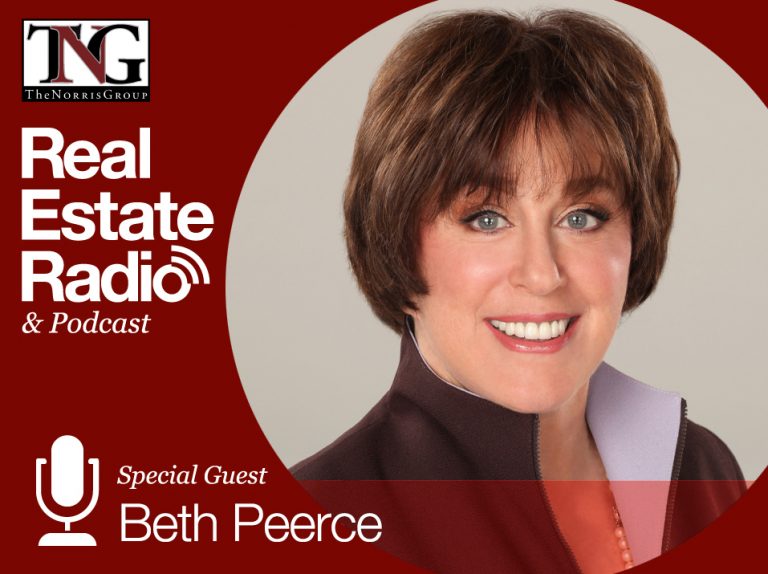
Bruce Norris is joined this week by Beth Peerce. Beth has been a realtor for more than 35 years and is the broker/owner of Primetime Properties in Century City, California. She is currently the vice-president for the National Association of Realtors. She was elected honorary director for life in 2006 and Realtor of the Year for California in 2012. She comes from a background where her family was in real estate as well.
Off air they talked a little about Beth’s mom. She was also an all-star in what she did in New Jersey, where she was also the Realtor of the Year several years ago. Real estate has changed Bruce’s life since he got involved in ownership for real estate. He always gets frustrated when he reads articles about people saying they will never own a house. He just read a big article in one of the L.A. papers about how smart it is never to own something. He just shakes his head at this since it has actually been a big benefit. Real estate did change in mid-70s when it became more than a residence and instead became an investment in people’s minds.
Bruce asked Beth when her mom was selling real estate, was it more for the purposes to live. Beth said it definitely was as well as for shelter. They did not want to pay somebody else rent every month but rather own their own home. For people in those days, the object was to pay with their mortgage. This was everyone’s goal; and Beth even remembers mortgage burning policies. It was quite a different thing then; but we still say the same thing that if you want to live in the home, then buy the one in which you want to live. Do not buy it because you think five years from now it will be worth so much more money. This may very well be true, but you are going to live there and buy something in which you want to live.
Whenever Bruce speaks in front of realtor groups, he always reminds them how important their job is because it was big deal for Bruce to become a homeowner for the first time. He has owned a lot of homes as well as sold them. The reason you own a home usually does not have to do with the numbers, but rather you get to call your own shots inside of that 70 by 100 lot. This means you can paint it, have kids, have a dog. People forget this is the basic right, the privilege of being an American, and why people come here. In the Los Angeles area that Beth lives in, they get a tremendous amount of foreign buyers. The buyers all say the same thing about wanting to raise their kids in a house and their grandchildren to be able to play in the pool. They want their own part of America. The more immigrants they get in, the more they will say the same thing about owning a piece of America. It seems like they appreciate that privilege more than if it has always been there for us.
In the area Beth is in where Beverly Hills is attached to the area you work and the assumption is that everything is multi-million dollars. Bruce asked Beth if this is the inventory with which she deals. She said in Beverly Hills it is certainly a much higher price range than most areas of the world, not including Tokyo, London, or New York. In Century City, however, it is much closer to the average norm in California where you can go get that 2-bedroom, 2-bathroom condo or a small home in the suburbs. It is still a much more affordable area, and there are certainly areas of Beverly Hills that are much more affordable too. We think of it as only having the most expensive real estate, but there are also areas that are buyable. FHA will not be doing loans in there any time soon.
Washington D.C. has a lot to do with how real estate does. In the early 2000s, the housing industry was probably backed by policy to do too great of an extent. Now with Dodd-Frank and the unwinding of that deal, Bruce asked Beth if she gets the sense at the end of the day that homeownership will still have a very special place in the hearts of the loan makers and they will want to encourage it instead of discouraging. Beth thinks they will if, for no other reason, that real estate is a very vital part of how our economy goes. When the real estate market goes down, the nation’s economy goes down. You need the financial well-being of all the Americans and their families to be able to live in the homes in which they choose to live. The tax provisions, mortgage interest deductions, and capital gains inclusions make a tremendous difference as to whether people can afford to buy a home. Beth hopes Congress will take all these things into consideration when making the new laws.
There is definitely a sense we are going to have to save money or decrease spending. Real estate certainly seems to be one of the prime targets from which they can take some goodies. Bruce read some of the legislation at the site of the National Association of Realtors, and he did not really realize 1031 exchanges were under fire. Everything is under fire, from your property tax deductions to mortgage-interest deductions and even to 1031 exchanges. They say they are looking at everything, but we are very hopeful they will understand they can do far more damage than the good they are trying to do. If you really discourage people who are entrepreneurs and who bought things with a certain set of rules in place, then you change the rules after the fact it will get frustrating. It is one thing to know all the rules upfront and say you will participate, and it is another to own something and reconsider it.
We really depend on people like Bruce who run radio shows to keep the public informed and lawmakers honest. One of the most discouraging statements he ever heard on the radio was when he talked to an economist who was very well known. However, he made a comment about Prop 13. Bruce said one of the problems about playing with Prop 13 is you have people that are seniors who have lived in homes and locations that have gone up extremely. They have never moved; they just live there. If you change Prop 13, there is a good chance they won’t even be able to afford their property tax. He said this is why they have reverse mortgages, which Bruce did not agree. This is the thing about some of the decisions we know have to deal with and that we all have people in our lives that are in those situations. We have to look out for people when they got into the situation when the rules were one thing. If they change drastically enough to where they cannot even live there, then they should maybe take a look at the rule change.
One rule in place actually surprised Bruce. There was a gentleman Bruce knew named Robert Bruss, a very smart man who had his own real estate column. The rule came out in 2003 where you could sell your residence every two years and make $500 grand if you were a married couple. He called him up to see if he was reading it wrong, to which Robert said he was not. The average family really does not make more than $500,000 on their property once they start to see what it costs them to buy it and what they have put into it.
Californians tend to do things to their homes to make them nicer to live in and what they want for a family home. When you start to subtract out those things, she is not sure this exclusion is used as much as we seem to think it is. You have a number of costs when you buy and sell the home, and anything you have done in that home to improve it can be written off to the cost of the house anyway. This could improve putting in a pool, remodeling the bathroom, putting an extra section in the kitchen. While the rule sounds terrific, she does not think they would make as much more money on our taxes if it were not there. Bruce asked what the one thing is they are eyeing that would make them a lot more revenue. Beth said there’s not clear answer since they are eyeing everything. To get rid of mortgage interest deduction, a number of years ago they limited it to $1 million, which most people understood. There were a lot of homes where people had loan over $1 million on it, but now some of the people are talking about taking it away. Some of the people are saying to bring it down to $500,000, but in her state or wherever they may be they do not have homes over $500,000. In California, you do not have to be rich to have a mortgage over $500,000; it just depends on the area in which you are living. It is all a very relative number, so we are hoping to keep it and keep the mortgage deduction the way it is.
When you are dealing with a negotiation, you have things that are like the Holy Grail of what not to touch. This would seem to be the interest rate deduction. It is possible that some of the goodies will have to be sacrificed for the Holy Grail section, so it will be interesting to see what happens. Bruce asked Beth if she thinks Prop 13 in California is under threat. She said this would only come in our own state because of the makeup of our legislature right now. However, every few years it comes up whenever we are bankrupt and do not have enough money for education or transportation. She is hopeful it was stay the way it is, whether or not it applies to commercial properties or residential properties. These come up on a more frequent basis, things such as a rental versus occupancy.
Bruce asked how the real estate business is doing in general as far as volume of sales. Beth said it had a tremendous increase in 2013, and in 2014 they are expecting to see this same upward trend. There has been a 20% cumulative increase for the last two years, and prices have gone up 18%. The problem with this is income has only risen around 3%. This does make it more difficult right now since we do not have our affordability index at the same place we did a couple years ago. The lower the interest rates, the easier it is to buy. Things are the best they have been in the past 40 years and the fifth year in a row for affordability to be good.
Bruce looks at the affordability index almost in reverse of most people. It is interesting to note that when affordability goes down, then what Beth said is true. You are still more affordable now than you were at almost any time in your lifetime. This is something very important for people to realize that if they are interested in owning a home, this is the time to go out and buy one. Interest rates are still at an all-time low. Beth came into the business when interest rates were going up to 19%. To her, she does not understand why people are complaining when it is 4 3/4. Bruce sees articles that say interest rates soar to 4 ½ and you worry. If someone had told you ten years ago that you would be able to get a 4 ½% interest rate, you would have laughed and asked them to show you. You can get a good fixed-rate mortgage and not one of those where you don’t know what will happen after a couple years.
When you say you have high affordability, the equal to that is that owning a home is taking less of your income and you have just fixed this to be true. You are now saying for the next 30 years as your income progresses, your housing costs are not only fixed but declining in ratio to what you make. This is a very big deal for household wealth, and this is what makes housing such a wonderful thing to have in our country, especially California. Bruce has interviewed Robert Schiller a couple times, and he is very against ownership even though he owns two of them. With the math he says he can prove it to be detrimental. Bruce said when he first bought a home it was in the mid-70s, it was a fortunate time in the sense they went up. Bruce remembered making $10,000 on the sale of his house; and this was all he made in a year at that time. He remembered asking what would happen if he owned two or three of them. He did this, and it went up some more. It took him four years to own a really cool home free and clear because he had bought more than one.
Bruce said it is interesting that his personal experience and the reason he has been able to gain some wealth is really directly attached to real estate. Unfortunately, it does go up and down and some of those cycles can hurt you. In general, you cannot talk Bruce into willingly being a renter because he knows his housing cost is directly attached to the whim of somebody else. Beth did not say there are people who should be renting until they are able to save enough to know they can afford all their housing payments. With the taxes, insurance, and mortgage you have to know you can afford this. But once you know you can, it is not going to change. At this point with Proposition 13, you know what your property taxes are going to be. Insurance is a variable, but they are trying to keep those under control. You also know what your mortgage is if you get a 30-year fix. As far as she is concerned, you cannot ask for a better situation than that.
When you have the ratio of debt, they talk about 43%. This number can go toward real estate debt or your overall debt. A big chunk of this is real estate; and when you end up owning this free and clear it is almost like you have financial freedom. What the seniors all used to strive for was getting to the point where they were free and clear of back payment and then they could live on the security they had put aside to live on for the rest of their lives. This is what you talk about when discussing Prop 13. We know this is one of the reasons why it is there.
Bruce said since he is an investor, people always come up to him and ask if they should refi their free and clear house. Bruce has told them no and that you sleep so well at night because of this. There are other ways to do it, and this is almost the Holy Grail of financial stability. Whatever happens outside, if you can go to a house that is free and clear when you sleep at night, there is something special about this in Bruce’s heart.
We have a better real estate market, but new home construction is still not too exciting. Bruce asked what is standing in the way of true recovery. Beth was not sure of the answer, but she thinks people are still nervous. The banks, government, and people are seeing what happened and getting concerned. The new QRM is proposing that you have to have a much larger down payment and they are not going with the same rules they have for their qualifying mortgages. They are not encouraging the buying of real estate, and she thinks if the government were to think about what happens to the economy when people are not invested in real estate, they would change some of the things they are doing.
In Riverside County, real estate is usually a big piece of our economy because of buildings and because we have land. The dangerous thing about charts is you can say construction is up 40% from last year, and that would be an accurate statement. At the same time, it is 80% from where it was. The significant thing for Riverside County is that lot creation is down 95%. There are some encouraging signs, but the most encouraging sign would be a builder saying they will write a check for a piece of land and develop lots since they see a clear future and path to profit. You do not see this reaction in the marketplace. In Riverside County, a county that normally has 300-350 sub-divisions, we had 23 in 2013. It has been bouncing there for the last 5-6 years. He could understand this being done in 2010, but after you sell every new house you could possibly build in 2013, you would think during 2013 somebody would write a check for some dirt and it did not happen. Part of that may be some of your government regulations that are out there now. Nobody is really sure why the builders are not jumping in at this moment because things are still reasonable and it is time to get back in the market. If you do stay, people will snap up those new homes instantly. There is always the idea that they want to have a new one and pay a premium for it.
In the next segment, they will really concentrate on some of the rule changes from Dodd-Frank and the purpose of the Financial Protection Bureau. He will be starting the segment talking about Fannie and Freddie since he has been watching the news over the last several months. This has turned into a very profitable business, so it is about time to end it. Beth said she strongly supports restructuring the secondary mortgage market, but will not support any entity that does not have a clear and explicit government guarantee. This is what ensures the availability of affordable mortgage credit. Unless we have affordable mortgages, no one can afford to buy a house. It is an interesting thing when you get the government involved. They have always been involved in Fannie and Freddie in a backup guarantee position. Now they happen to own them, so it creates another level of involvement.
Tune in next week as Bruce continues his discussion with Beth Peerce on the Norris Group real estate radio show.
MORE ON HARD MONEY LOANS
- Florida hard money loans or call (407) 706-9700
- California hard money loans or call (951) 780-5856
INFORMATION ON NOTE INVESTING
- Florida mortgage investing or call (407) 706-9700
- California trust deed investing call (951) 780-5856
REAL ESTATE INVESTOR EDUCATION & RESOURCES
- Upcoming real estate investor speaking engagements and training
- Real Estate radio show and podcast
- Weekly news and videos
- Free Investor Roadmap – How to get started in real estate investing
- Free access to our web portal for real estate investors