

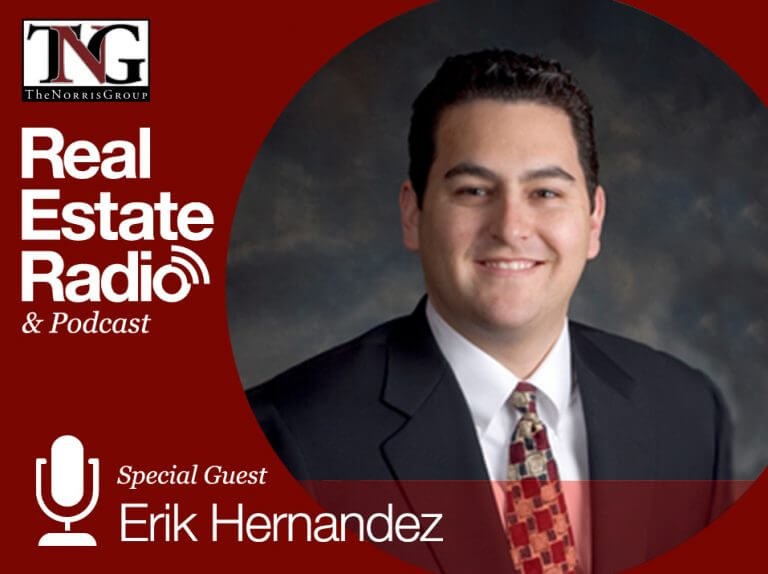
Bruce Norris is joined this week by Erik Hernandez. Erik is the senior vice president with Lee and Associates. He specializes in commercial real estate, his exact specialty being industrial real estate. He specializes in land sales and development representation, landlord representation, and investment sales and analysis.
The last time Erik and Bruce spoke, the market was a little more different than it was today. The last time they talked was back in 2009. Bruce asked about the peak of the market that Erik was most familiar with and what year this peak occurred. Erik said the peak of the market in the commercial world was in the summer/fall of 2008 when everything started to hit the fin. One of the best pieces of insights he ever heard about the real estate market was from a lender/financier who was a real expert when it came to financing real estate. He said property was worth what he can lend against it. When the lenders disappear or their lending criteria changes, unlike the residential side, the industrial commercial side saw a lot of money out there chasing deals. When this started to go away, a lot of appetites changed. We are influenced by job creation or job loss because this affects our supply and demand. If you go back and look at the job numbers in 2008 and 2009, we were losing a quarter of low seven-figure jobs. It was pretty dramatic and in such a short period of time.
Bruce asked about the peak of the market before problems occurred and what would have been the motivation for the buyer to enter the market at this price point. Erik said in his market there are several different classes of buyers, so maybe we should try to understand this a little bit more. In their market they do a lot with companies and investors that buy property as well as companies that rent property. A lot of corporations or businesses strictly only rent properties, so we should think of this in both dynamics. On the investment buy side, both from an acquisition point for a company to invest to either occupy the building or own it and collect income on it, there is still a feeling of the ability for rents to rise. If rents are rising and cash flow is good, this means that continued good returns are possible.
Another aspect was they had 4-5 years running of significant annualized appreciation. People can look backwards, see what they missed, and feel like if they did not get into the market they were going to continue to miss out. There was a lot of money that still entered the market, even at that late stage in the game that still wanted to be here in Southern California in particular. Real estate loans had their version of stated income, but what they had in the commercial side was projected rent increases. This is something they call pro forma rents, which obviously did not occur. When you underwrite a real estate transaction, like anybody your crystal ball can only go out so far in time. Erik said his does not go out very far. He knows Bruce has one that works for the cycle on the residential side, which is magic. They are not unlike this on the commercial side, but the rent growth that was projected peaked back in 2008.
Anybody who had underwritten or relied on future price appreciation or pro former rent growth was really left holding the bag. If they looked at what would be a normal vacancy rate, this probably did not occur either. They worked with a couple large tenants at that time, and it turned out late 2008 and 2009 was one of the best times to be a tenant. This was because the landlords who were sitting on vacancy, especially some of the large companies that were publically traded and industrial real estate investment trusts that have quarterly reports they owe to Wall Street. They have investors analyze them, and they had a mandate to fill their vacancy no matter what. The first few amazing deals that happened went down with prices where nobody thought they would step so low and so fast to achieve. The philosophy of that time is if you want to be the first deal at that price or the twelfth one a year from now. Since this is the direction, it usually gets lower and lower.
The declining rents really affect value and commercial real estate. This really changed the valuation over night when you had so many vacancies to where, even if you were an existing tenant and could dictate a discount, you were devaluing the value of the property at almost a year or two after lenders were more aggressive than they had ever been. It is actually a double whammy because you are looking at declining rents and appreciation. The interesting thing that happened in the market was that it is heavily driven by construction. Out here it is speculative construction. It’s the kind of market where if you build it, they will come. Erik said they have been a beneficiary of being in the greater Los Angeles basin. They are the beneficiary of a lot of companies that want to be in Southern California. They are physically priced out or cannot get what they need in terms of a state of the art large industrial building in Los Angeles. If they really want to be in Southern California, they have to be out here today.
With the big wave of construction that happens, you had a lot of construction loans that were placed against those properties. You could not replace those construction loans with permanent financing at that time. What happened in the 90s was all those properties typically went back to the bank. This time, the mandate of the FDIC director was to avoid a repeat of the 90s where they did this massive liquidation. Everyone wanting to buy properties through the ROTC came out smelling like roses not more than two years later. The residential problem set the table for being reasonable with commercial problems. This time around, a lot of the lenders were not just banks, but life companies, pension funds, private equity.
A lot of what went on during this cycle was the old “blend and extend.” You may not have typically seen loans get replaced, but they were written down and people may have contributed equity to the deal and were able to extend the loan for a period of time. They essentially bought themselves enough time to get out of most projects that would have had major issues. It was a very different story in the 90s when things were very different. He recalled looking at a chart of payoffs. If you look at a chart of commercial loans, the last two years as well as the next 2-3 years have this gigantic number of billions of dollars in loans that have a due date. If you look at the chart, you think it is going to be a historic number of foreclosures. It has not materialized unless it is in an isolated area.
Something the general public might not realize is the CMBS market and the resets that are happening now over the next two years. The way those deals are structured is they have a return on the notes that were underwritten for the property. However, those were guaranteed returns. You cannot just call the bank or whoever holds the note at this point and tell them you want to pay it off. If you do, the prepayment penalty is massive. In some cases, it could be 20-30% of the outstanding principal. If you do not have to do this and the market is rising, then you are waiting it out right now hoping the market continues to your advantage. Then next year or later you may replace that debt when it comes due with new conventional financing or some other type of financing. It depends on the market conditions.
Erik said he has several clients who shared with him that although most people would think the worst was behind us, hopefully it will be the beneficiaries of this still very accommodative lending environment that is becoming very accommodative right now. They will be getting the best of both worlds. They were able to hang onto a property they may have had issues with and maybe even put better finances on it than they have right now. If your income stream is the same and you reduce your debt payments per month, your overall cash flow goes up dramatically. It is not unlike a homeowner who was able to refi their home like Erik did, going from 6% to below 4%.
In the residential world, lenders never make loans with the thought they will get the assets someday. Bruce asked Erik what it is like on his side when the lender makes a loan. Bruce said he does not think they are ever after the asset. Most of the time their interest is strictly on the returns they get on the yield. The calmer the better. They do not want the excitement of foreclosing and kicking out tenants who are living with a bad lease. They just want a check. When this all started, most of the major institutions did not have a fully staffed REO department or “special assets.” They had to staff up for this. Everyone from the institutions, lenders, life companies, or whoever serviced the assets along with the escrow title companies had skeleton crews and had to really staff up for this.
The FDIC location down in Irvine closed about a year and a half ago, and a lot of the REO departments have been consolidated into one location where they originally would have had people scattered around. They did not need that manpower anymore. When we talk about commercial real estate, it is this big umbrella. Bruce asked to talk specifically about office space and if it was one of the harder hit segments of commercial real estate. Erik said it was, and you could probably argue that it was office or retail that was hit the hardest out here in the Inland Empire. In order of hardest hit, retail would come first. From there, you would go to industrial, and multi-family would be the first to recover. Because of everybody getting foreclosed on, there was a lot of new renters. The multifamily market hit the wall for a little bit, but this was the first property class to really see new construction.
Erik said he remembers seeing apartments under construction out here as early as late 2009. This was good timing because most of the time you are seeing construction at a time when it takes a while to get plans and permits. What is interesting is these people probably want to be homeowners again, so he is not sure their vacancy rate is going to be as good as they think it is. It will be interesting to see how this develops, but the housing market created instant renters for the multi-family asset class. The government and lenders was probably the easiest asset class to get a loan. You had everything going for you, including demand and people willing to loan you the money to go out and buy properties.
Bruce asked what segment of real estate is the most expensive to build if we are talking office, retail, or industrial. Erik said they all have their different aspects on what it requires to build. A fully improved office building would be the most improved expense, especially something over three stories. You do not see a lot of this happening out here. There is an office building under construction in downtown L.A. that is going to be the tallest building left of the Mississippi. It will be like the Willis Tower in Chicago where you will have a deck, possibly even a pool. This is one of the first major office buildings to be constructed in downtown L.A. in years. It was a site that a Korean Airlines owned, and it will be a very impressive building when it is done. Bruce asked if in Riverside and San Bernardino County it pencils to build office space yet or if there is still existing inventory far less than the cost to build. Erik said it is almost there and that there have been some office projects that have been standing inventory for many years. The office brokers in Erik’s office have said the last great deals that are still priced below replacement cost. If they are not already gone, they will be gone here before the end of the year. This, along with demand, will start to spur new office construction. They are seeing some of this now, but it is more of a build to suit nature. There is really no speculative office construction happening right now, but there are people who are starting to talk about this.
Bruce asked when you talk about the size of the building, if you have an REO that was 4,000 square feet or 30,000 square feet, which is the easier one to fill with a tenant. Erik said the for the office side it would be the larger footprint. Erik said since his specialty is zeroed in on the interest side, he is speculating here. The smaller ones are still in the startup stage of the market. A 30,000 square foot office deal out here is still a pretty large deal for this market.
On the industrial side, Bruce wondered where he sees this market from the bottom to where we are now. He asked what price increases we have had and if we are having rent increases and vacancy declines. The price increase off the bottom has been very dramatic. They are looking at evaluations now where if the trend continues into the next year, we will be approaching peak valuations we hit in the last cycle. There are a lot of people out there who think this price wing still has a lot of momentum to go. Bruce asked why this is the case and if it is because income has dramatically increased from the prior peak. Erik said in our market here, we talk about valuations. Real estate valuation has a metric that is not unlike when you look at a stock and see the price to earnings ratio. Here we have what is called a cap rate, which is a percentage of return based on the first-year’s net operating income that an investor might look to acquire a property. The higher the cap rate, typically if the rent is the same, the lower the price per square foot.
The cap rates out here have continued to fall, and we are in an environment of rising rents. You compel these two things together, and this has continued to push valuations higher. You could say in the same sentence that the value of the building in dollars is reaching its past peak, but we are not reaching the cap or rent bottom or ceiling. For example, if cap rates today were 5% and, with all things being equal, if the rent and valuation are the same but the rent continues to rise, the overall building valuation will continue to rise. Even if they expect rates of return to stay the same or the cap rate dipped up slightly, if the rents continue to grow at a 5-10% clip annually, you will continue to see this rise in underlying asset value. This is what is driving some of the money that is looking for deals in the market today.
What is interesting is we have gotten here without the help of the construction world. There are not a lot of homes being built. Bruce asked if this affects industrial space or another part of real estate space. Erik said it is probably a mix of office, mostly industrial. When you get into the industrial side, this is the supply chain for the homebuilding side. You have the guy with the little office in the warehouse for almost everything as well as the granite guy, tile guy, flooring guy, carpet guy, framers, aluminum companies, window guy, and all the way down the food chain. There are so many different people involved in what it takes to build a home that we are just seeing that first wave of companies looking to do things again. We have not even had that follow-through in this segment of the market we are heavily influenced by out here.
If we continue at the pace a year from now and are at the value peak, Bruce wondered if this has been assisted by the same speculative type of financing. Erik said not yet. The one thing about predicting things is that it is not just statistics, but human nature. Commercial lenders or whoever is ultimately financing this, whether it be Wall Street or the willingness for people to take risks, we seem to take the same patterns. You would think as prices escalate you would find more creativity in financing start to occur. There is a cycle that happens when everybody retreats. On the commercial side you have your basic lending institutions, then you have mezzanine financing.
If you want to buy a piece of property that is $100, the bank will lend $70 on it. This means you would have to put $30 of your own money into it. When the market was really bad, the lender would only give about $55. Now they will give you $70. The difference today is you may go get some type of equity partner or preferred return private money person. He may loan you $25 to be in a second position so that you only have to put $5 of your own money into the deal. If your hold is a 2-4 year hold, you will get a preferred guaranteed return if the project goes well. You would only have to put $5 of your own money in it. However, if the property is worth $150 a few years from now and you exit, you would look great because you delivered great returns for everybody. Everybody gets their money back, and you come out smelling like roses.
Tune in next week as Bruce continues his discussion with Erik Hernandez of Lee and Associates.
More on Hard Money Loans
- Florida hard money loans or call (407) 706-9700
- California hard money loans or call (951) 780-5856
Information on Note Investing
- Florida mortgage investing or call (407) 706-9700
- California trust deed investing call (951) 780-5856
Real Estate Investor Education & Resources
- Upcoming real estate investor speaking engagements and training
- Real Estate radio show and podcast
- Weekly news and videos
- Free Investor Roadmap – How to get started in real estate investing
- Free access to our web portal for real estate investors